
There are four things that can make a sex swing unsafe. None of them are complicated. All of them are preventable. This page covers each one directly, because we have seen what happens when people skip them — and it is not interesting in any good way. We have been selling and testing sex swings since 2012. The stories in here are real.
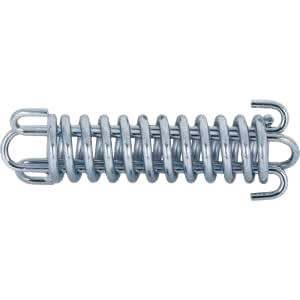
1. Use the spring. Every time. No exceptions.
The spring is not an add-on for bounce. It is an engineering and safety requirement.
Every mounting point has a load limit — not just the weight sitting in the swing, but the impact force every time the swing changes direction. Without a spring, those shocks go straight into your ceiling hardware on every single movement. They accumulate. Hardware that holds fine under static load can fail under repeated impact load at a fraction of the rated weight.
We have seen a 95-pound woman use a swing like a crazy woman for a couple of hours and break a stand rated for several hundred pounds. When we asked her about the spring, she said the box (another brand) told her she didn’t need it at her weight. So, she didn’t use it.
That is why this section exists.
“The spring was put there by the designers and engineers to add dampening to reduce the shock force on the point where you mount the swing.”
Some manufacturers recommend removing the spring if you exceed a certain weight. This is wrong, and we do not know why it is still on packaging. Lighter people move faster. Faster movement means sharper impact loads. The spring matters at both light and heavier loads. A spring is non-negatable.
The drawbar spring vs. the extension spring
Most swing brands ship with an extension spring. It stretches under load and has a weight limit – typically around 200 lbs. Push past that limit and you risk permanent deformation (stretching out). A deformed spring does not give you a warning. It just stops absorbing shock the way it should.
Every Screamer swing ships with a drawbar spring instead. A drawbar spring compresses rather than stretches. It has a higher weight limit – 300 lbs – and if it does hit that limit, it compresses onto itself rather than deforming/stretching. That means it fail safe. An extension spring at its limit will fail.
We carry drawbar springs and in our opinion they are the only safe option.
2. Check the swing and mounting hardware before every session.
Two minutes. That is all this takes. You are looking for anything that was not there last time.
- Straps and webbing: run your hand along every strap. Look for fraying, cuts, or any wear at the points where straps pass through hardware. Webbing does not fail in the middle — it fails when rubbing on the hardware.
- Buckles and clips: squeeze each one. A buckle that slips under hand pressure will slip under load. Any crack in a buckle is a reason to stop.
- Your mounting point: look at where the hardware meets the ceiling or stand. Check for movement, cracking in the ceiling material around the mount, or any sign that the hardware has shifted. A joist mount that was solid at installation should not wiggle.
One thing people do not think about: pets. If your dog had access to the swing between sessions, start with the webbing. Stitching that has been chewed does not always look obviously damaged from three feet away.
3. Never adjust a weight-bearing strap under load.
If something needs adjusting while someone is in the swing, stop.
Remove the weight from that strap completely. Adjust. Get back in.
A sudden adjustment under load creates a drop. At best it is startling. At worst it puts a shock load on the mounting point that is significantly higher than anything the swing produces in normal use. This is the kind of thing that is obvious in retrospect and completely preventable.
This is also why the dry run matters. If you get in the swing before the first real session and dial everything in while you are calm and clothed and thinking clearly, you will rarely need to adjust anything mid-use. Do it once. Do it right. Then you do not have to think about it again.
4. Once the ceiling mount is in, leave it there.
If you have a ceiling mount: do not remove and reinstall the hardware in the same hole.
The second installation is meaningfully weaker than the first. The wood fibers that give the lag bolt its grip are already compressed and displaced. You cannot see the damage from outside. The mount may feel solid and test fine under hand pressure. It is not the same mount it was.
If you need to move the hardware, go to a new location entirely. Cover the old hole with a plug, a touch of spackling, and a paint match. Or leave it and hang a plant from it. Both are fine. What is not fine is reinstalling in the same hole and trusting that hold.
The version of this we see go wrong
It always follows the same pattern. Someone buys a swing, skips the dry run, skips the spring or uses an underrated one, and uses it without checking the hardware. Nothing happens the first time. Or the second. The hardware is quietly accumulating stress it was not designed to absorb. Then something gives- usually at the most inconvenient moment possible.
None of it is dramatic or complicated to prevent. Use the drawbar spring. Check the hardware. Do not adjust under load. Do not reinstall in the same hole. That is the entire list.
The hardware that makes this easier
Every Screamer swing ships with a drawbar spring already included, because we made the decision years ago that it was not optional. Other brand swings do not.

